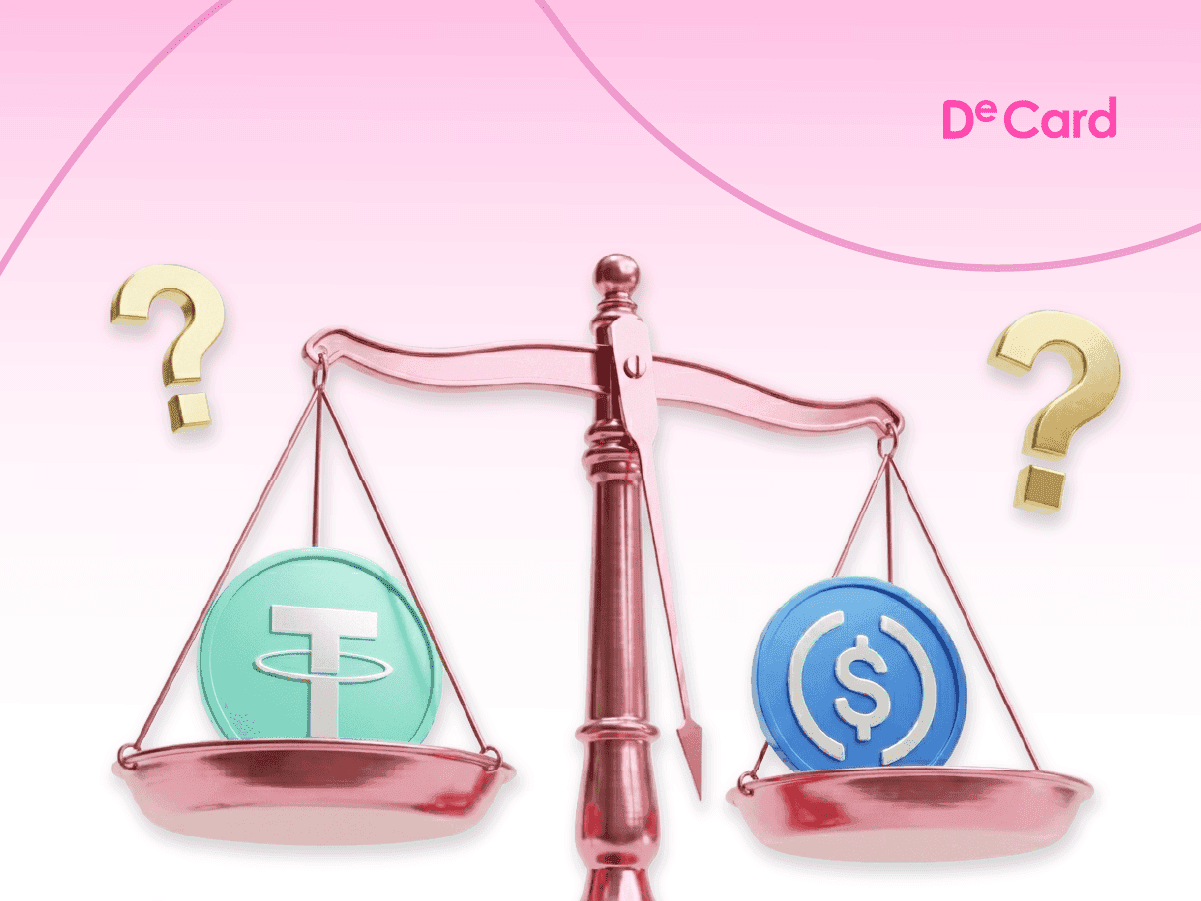
USDC vs. USDT: What's the Difference and Which Should You Use?
USDC and USDT are both dollar-pegged stablecoins but they're not the same. Here's what sets them apart and how to choose.
What Are USDC and USDT?
If you've spent any time in the digital asset space, you've likely come across two names more than any other: USDC and USDT. Both are stablecoins, digital tokens that maintain a stable value by pegging to a real-world currency. While stablecoins can track a range of currencies, the US dollar is by far the most widely used, and both USDC and USDT are pegged to $1 USD. Together, they make up the overwhelming majority of the $300 billion stablecoin market, according to CoinMarketCap.
But while they share the same dollar peg, they aren't the same product. They're issued by different companies, backed by reserves in different ways, and carry different reputations when it comes to transparency and regulation. For anyone using stablecoins for everyday spending, payments, or transfers, understanding the distinction is worth a few minutes.
If you're new to stablecoins entirely, it helps to first understand how stablecoins work in our guide.
USDC vs USDT: Key Differences in Reserves, Transparency, and Availability
Market size and liquidity
USDT (Tether) is the older and larger of the two. Launched in 2014 by Tether Limited, it is the most widely traded stablecoin globally by volume and holds the larger market cap of the two, with over $180B in market cap. Its liquidity and exchange availability are unmatched, being accepted almost everywhere.
USDC (USD Coin) was launched in 2018 by Circle, in partnership with Coinbase. While it holds a smaller market cap than USDT, it has been growing at a faster rate, outpacing USDT's growth for the second consecutive year in 2025. This momentum is largely driven by institutional demand, with Visa, Mastercard, and BlackRock among the names actively using USDC for settlement and treasury operations, according to CoinDesk.
Reserve composition
USDC reserves are held almost entirely in cash and short-dated US Treasury securities. USDT's reserves are broader in composition, including Treasuries, gold, Bitcoin, and secured loans. Both stablecoins have briefly traded below $1 during periods of market stress and both recovered, but USDC's more straightforward reserve structure has made it the preferred choice in compliance-sensitive environments.
Transparency and regulation
Circle has published monthly reserve attestations since USDC's launch and holds regulatory licences across the US and Europe, including compliance with the EU's MiCA framework. Tether has improved its reporting over the years, but S&P Global flagged in late 2025 that gaps remain around custodian details and asset segregation compared to regulated market standards, according to The Block. It is also worth noting that USDT currently remains unregulated in the US and Europe.
For a deeper look at how reserve-backed stablecoins maintain their peg, and where the risks lie, see our article on whether stablecoins are really stable.
Should you use USDT or USDC?
The simple answer is: it depends on what you're doing and where you're holding your assets.
Use USDT if you value liquidity and broad exchange availability. It's available on more trading pairs and is often the default stablecoin on many platforms, making it the stronger choice if ease of access is your priority.
Use USDC if transparency and regulatory compliance are important to you, particularly if you're using stablecoins for business payments, holding larger amounts, or moving funds through platforms with stricter compliance requirements. Its reserve disclosures offer clearer visibility into what's backing your tokens.
For everyday spending, the practical difference between the two is minimal, which is good news because DeCard supports both. When funding your card, both USDC and USDT are accepted across multiple blockchain networks:
- USDC: Polygon, Solana, Base, Ethereum
- USDT: Polygon, Solana, Tron, Ethereum
One important thing to keep in mind: the network you select when sending must match the network selected in the DeCard app. Getting this wrong can result in lost funds. For a full step-by-step walkthrough of the funding process, see our guide: How to Fund Your DeCard with Stablecoins in Minutes.
Whichever you choose, DeCard lets you spend both. Sign up today and put your stablecoins to work.