
Why Web3 Cards Can Save You More on International Spending
Hidden FX fees can cost you more than you think. Here's how they work and how Web3 cards offer a smarter alternative.
International Spending Comes With Hidden Costs
International travel and cross-border shopping are at record highs — 1.52 billion tourists travelled abroad in 2025, spending US$1.9 trillion globally, while cross-border e-commerce now exceeds US$1.2 trillion. But every swipe abroad comes with a cost many overlook: foreign exchange fees. These small percentages quietly add up with every transaction. Understanding how FX fees work, and how different cards handle them, can help you avoid surprises and keep more of your money.
How Traditional Bank Cards Handle FX Fees
A foreign transaction fee is a surcharge applied when you make a purchase outside your home country or in a foreign currency, whether you're traveling abroad or shopping online from an international retailer.
Traditional bank cards typically charge two separate costs when you spend internationally:
Foreign transaction fee
This is an explicit fee charged by your card issuer for processing international transactions. It usually consists of a network fee (~1%, charged by the payment network for currency conversion) plus an issuer fee (an additional 1-2% added by the card-issuing bank). Combined, this typically adds up to 2-3% of every transaction.
FX spread
On top of the transaction fee, many banks also apply an FX spread — a markup on the exchange rate itself. Instead of converting your money at the mid-market rate (the real exchange rate you'd see on Google), they use a less favorable rate and pocket the difference. This spread often doesn't appear as a separate line item on your statement, but it can add another 1-3% to your effective cost.
When you combine the foreign transaction fee with the FX spread, the total cost of spending abroad on a traditional bank card can reach 3-6% of your transaction value.
For example, on a $5,000 overseas trip with a 3% foreign transaction fee and 2% FX spread, you'd pay $250 in hidden costs. For frequent travelers or regular cross-border shoppers, these costs compound quickly.
How Web3 Cards Handle FX Fees
Web3 cards, typically funded by stablecoins, take a different approach to international transactions. While specific mechanics vary by provider, several factors can reduce the cost of spending abroad.
Many Web3 cards are funded with US dollar-pegged stablecoins like USDC and USDT, which simplifies currency conversion compared to volatile digital assets. Transactions often pass through fewer intermediaries, reducing the layered fees common in traditional banking. Many providers also publish FX rates upfront, making it easier to understand what you're paying for, without the hidden spreads.
Simplified FX spending with DeCard
DeCard charges a 1.8% FX fee on international transactions, significantly lower than the typical 2-3% foreign transaction fee plus additional FX spread that traditional cards often charge.
For users who hold stablecoins, DeCard offers another key advantage: no conversion hassle. If you earn in stablecoins or simply prefer holding USDC or USDT, you can spend directly without needing to off-ramp to fiat first. This eliminates additional exchange fees and the friction of converting through traditional banking rails. Your stablecoins convert at market rate with 0% markup on digital asset conversion, so you're not losing before you even spend.
DeCard also keeps costs simple — there's no funding fee when you top up and no annual fee, so you know exactly what you're paying for.
What Lower FX Fees Mean for Your Wallet
The difference between 1.8% and 3-6% might seem small per transaction, but it compounds over time.
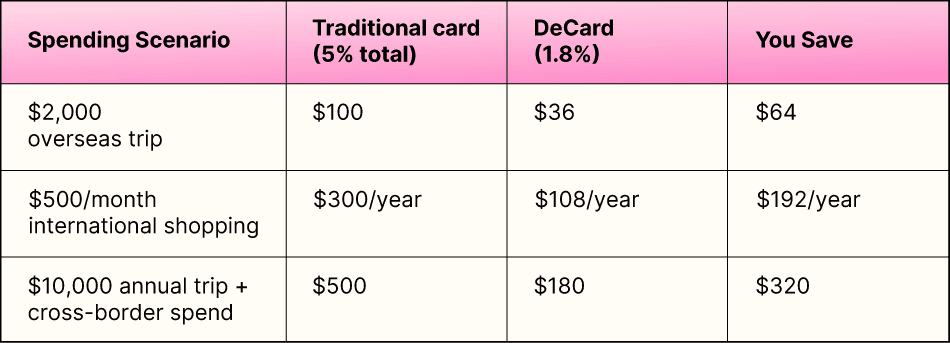
For stablecoin holders, the savings go even further by skipping off-ramp fees and exchange spreads.
Spend Smarter Abroad with DeCard
FX fees are easy to overlook, but they add up. For travelers and cross-border shoppers, choosing a card with lower fees and transparent pricing makes a real difference.
DeCard offers 1.8% FX fees and lets stablecoin holders spend directly without any conversion hassle, making international spending simpler.
Start saving on your international spending with DeCard.